Greenware Compaction & Plasticity Tolerances • Section 02 • Rev. 2026
Mechanical Compaction

Ceramic Forming: Greenware Engineering

Achieving geometric stability prior to firing requires strict control over moisture gradients, clay platelet orientation, and compaction density. Examine industrial methodologies across hydraulic pressing, rotational jiggering, and hollow slip casting.
REVIEW FORMING PROTOCOLS
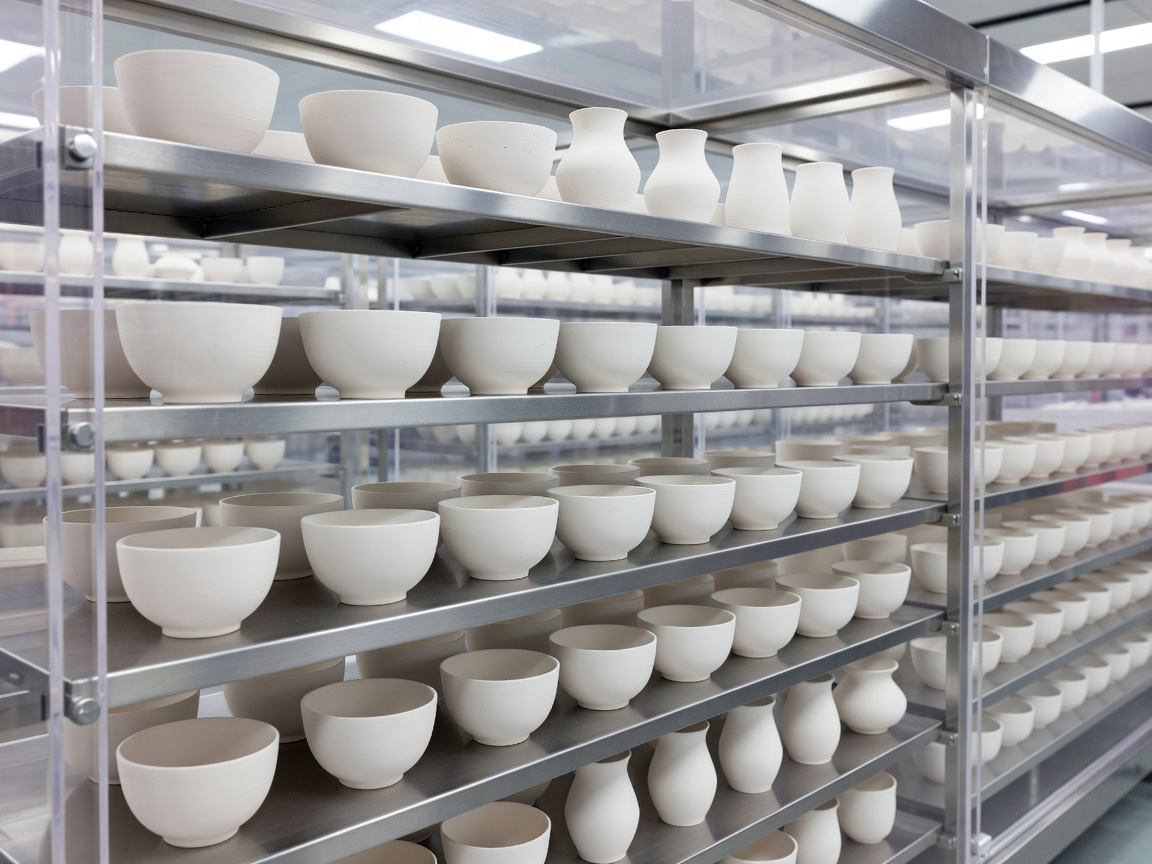
White porcelain greenware vessels drying in precision climate-controlled rack chambers
DRYING SHRINKAGE: 5.8% // MOISTURE: 1.5%
Production Modalities

Industrial Forming Comparison

ISO-FORM-44
Methodology A

Slip Drain Casting

Employed for intricate asymmetrical geometry, teapots, sanitaryware, and sculptural vessels. Plaster-of-Paris (hemihydrate gypsum) tooling draws water from deflocculated slip through sub-micron capillary channels.

  • Plaster-to-water ratio: 100:72
  • Wall build rate: 0.12 mm/min
  • Drain point viscosity: 320 cP
TOOLING: GYPSUM #1 WALL: 3.5 MM
Methodology B

Roller Jiggering

Flatware manufacturing standard. A heated rotating profiled head shears plastic clay against an open revolving plaster mold, uniformly distributing clay grog and eliminating directional warpage.

  • Head temperature: 95°C – 115°C
  • Cycle rate: 14 pieces / minute
  • Moisture content: 22.5%
AXIAL SPEED: 380 RPM TOLERANCE: ±0.3 MM
Methodology C

Isostatic Dry Pressing

Granulated ceramic spray-dried powders (approx. 4% moisture) undergo triaxial compression inside elastomeric polyurethane membranes at extreme pressure. Zero drying shrinkage eliminates distortion.

  • Pressure rating: 1200–2000 bar
  • Binder system: 1.5% PVA / PEG
  • Green density: 1.95 g/cm³
PRESSURE: 150 MPA SHRINKAGE: 0% DRY
Drying Mechanics

Controlled Environmental Drying Curves

HYGROTHERMIC EQUILIBRIUM
85% RH

Phase 1: Leather-Hard Plastic Transition

Relative Humidity 85% // 35°C Temp
Inter-particle moisture recedes. Clay platelets move into direct contact, inducing 85% of total drying shrinkage. Humidity must be maintained high to prevent edge-to-base differential drying.
35°C
40% RH

Phase 2: Pore Water Evacuation

Relative Humidity 40% // 65°C Temp
Capillary menisci retreat into interior void channels. Physical shrinkage ceases completely; volumetric dimensions stabilize as greenware reaches bone-dry stage.
65°C
<1% H2O

Phase 3: Kiln Preheating Thermal Balance

Relative Humidity 10% // 110°C Temp
Total stripping of hygroscopic ambient moisture. Prepares greenware structure for entry into kiln firing without risk of steam-induced micro-fractures.
110°C